
Reading
At Earl Sterndale C of E Primary School, we believe that reading is a fundamental life skill and the key to unlocking the wider curriculum. Through our whole-school approach, we aim to ensure every child becomes a confident, competent reader who not only understands what they read but develops a lifelong love of books. We know that confident readers can access a broad range of experiences, enjoy diverse genres, and use reading to acquire knowledge, stay informed and achieve success.
From the very start of their educational journey, children are encouraged to explore books positively. Across the school, we provide access to high-quality, age-appropriate literature in a variety of environments, enabling children to make personal choices and develop their own interests. Our curriculum promotes reading for both pleasure and knowledge, highlighting its essential role in everyday life.
We use a range of strategies to help children read with fluency and understanding. Reading is taught through daily phonics sessions, small-group interventions where needed, reading practice sessions and English lessons. Opportunities to read are embedded across the curriculum to reinforce its importance and relevance.
Our love of reading is celebrated through events such as World Book Day, where children share favourite books, dress as beloved characters, and take part in a book swap. We also foster friendships and a shared reading culture through initiatives like Buddy Reading, pairing older and younger pupils to enjoy books together.
In the Foundation Stage
In the Foundation Stage, early reading and phonic knowledge is developed. The school uses a systematic Phonics scheme as a basis for teaching. In September, most children are ready to begin working at Phonic Phase 2; they will have experienced a wealth of listening activities, and will be able to distinguish between speech sounds. Some will also be able to blend and segment sounds orally.
In Key Stage 1
In Year 1 and 2 the children continue reading using our Phonics scheme. We have a wide range of fiction and non-fiction books, and children are supported to read books aligned with their Phonics development.
All pupils participate in Reading Practice sessions three times a week, to develop key skills:
Decoding (the process of translating written or printed text into spoken language)
Prosody (the rhythmic and melodic aspects of speech; reading with good expression and intonation, including pitch, tone, volume and emphasis)
Comprehension (the ability to understand and make meaning from what has been read)
Once they have practised these skills with staff, they then bring the book home at the end of the week to 'show off' and share what they have learned.
Some children will also be heard read on a more frequent or even daily basis as required.
Alongside decoding, children also have frequent opportunities to practise and expand their ability to read and spell whole words. They are taught ‘tricky words’ or 'common exception words', which are those that do not follow typical patterns e.g. the/would, and instead need to be remembered as complete units.
All pupils select books from our Link Library, which they are welcome to change as often as desired. Parents are encouraged to share these books at home. The purpose of these texts is to develop a love of reading, rather than specific reading skills. Therefore, the books will often be outside the scope of your child's reading ability; parents/carers will be able to read them TO their child instead. Discussing events and vocabulary will further support your child's development.
A love of books is promoted across the curriculum, and specifically by daily story time (which is split for Years 1/2 and EYFS to ensure age-appropriateness) and a text-led writing curriculum.
Books sponsored by https://www.webuybooks.co.uk/.
Phonics
Information about Phonics teaching can be found on this page.
Supporting Reading at Home
To ensure all our children become successful readers, we work collaboratively with our parents and the wider community and recognise that it is a team effort in engaging children with reading. Parents and carers are invited to come in; we also have a range of volunteers from the local community who come in and read with the children on a regular basis. We work in partnership with our parents to acknowledge that a child’s reading experience is much more than the reading book which comes home from school. It is reading, sharing and listening to a wide and varied range of genres for real enjoyment.
-
Read regularly- It only has to be a short period of time and sometimes it could be you reading to your child or them reading to a teddy. During these times ensure to discuss the text and ask a few questions about what they have read. We encourage children to re-read their books several times to build their decoding skills, fluency, comprehension and ability to read with expression.
-
Update Reading Records- After reading, update the yellow reading record with what you have read and how they did. Was there a specific sound that was tricky or a word they did not know? Your comments are really valued.
-
Have a book bag- Ensure that your child has their named book bag in school every day.
-
Wider Reading- Please encourage children to read their own books alongside their school books as well as encourage reading whenever it is happening- even if it is looking at a menu when you are having a meal at a restaurant. A wide variety of text types is essential to supporting children in becoming successful readers with a life-long love of reading.
-
Keep reading fun- We want our children to develop a love of reading and engage with the opportunities provided of them. If this means you share the load and read a page each, or sometimes you read to them, then this is absolutely fine. Remember to speak to your child’s class teacher if you need any support with engaging your child with reading.
Did you know? If you read just one book a day to your child, they will have read 1825 books by their 5th birthday; every day counts - every book counts!
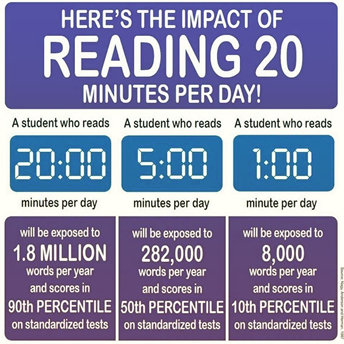
Please explore the documents below for more information about how you can support your child's development.